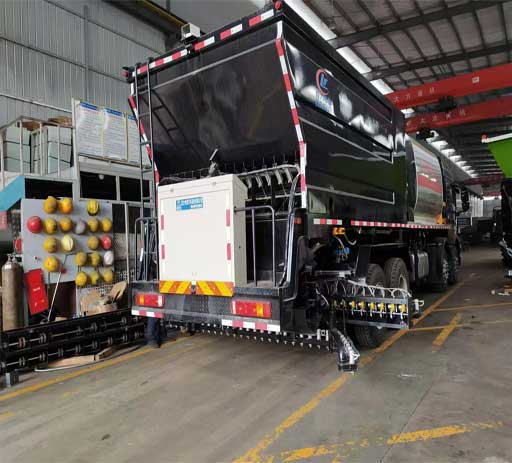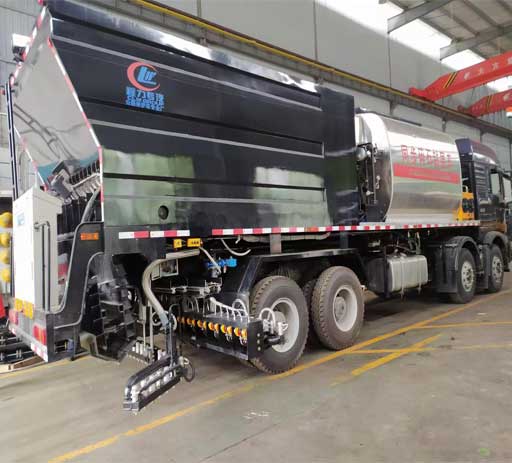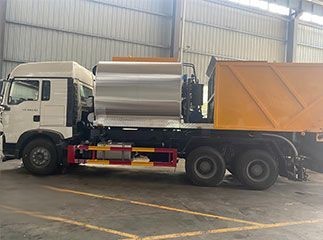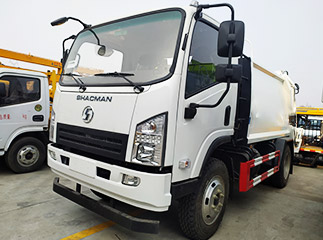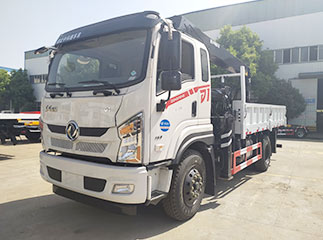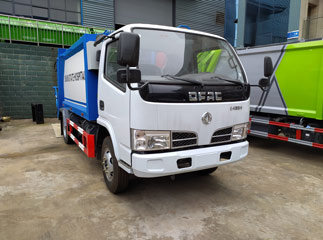
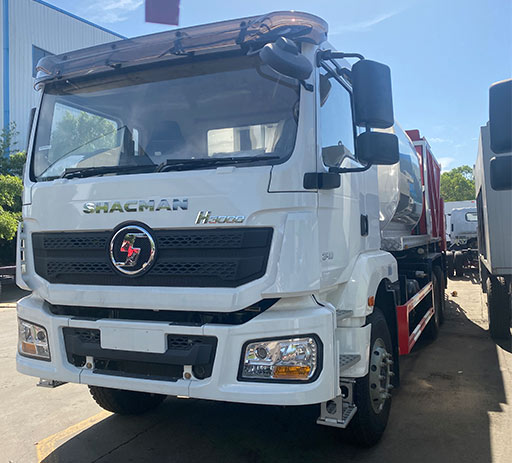
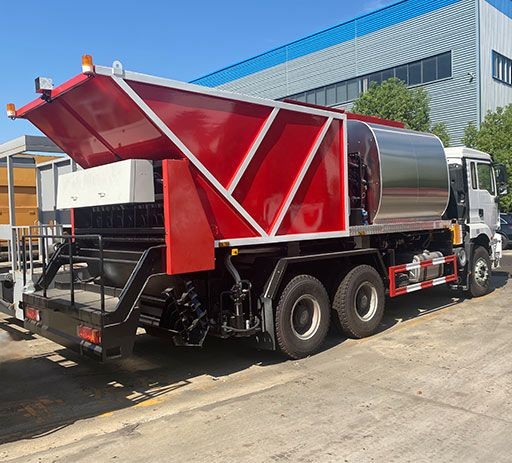


shacman chassis, weichai 340hp, diesel engine, 12+9 cbm bitumen and chipping tank capacity,with power generator, heat preservation layer, international famous brand burner, bitumen pump and other hydraulic units, used for asphalt/bitumen distribute in road construction site
Currently, the gravel spreaders used in mainstream vehicles can be categorized into two types: the first type is the free-fall type, which mainly relies on the gravity of the gravel itself for free-fall feeding or spreading; such as fixed hopper type, lifting hopper type, and combined hopper type gravel spreaders all belong to this category; the second type is the mechanism-driven type, which is driven by some mechanism to transport and spread gravel, such as belt conveyor type spiral spreaders.
(1) Fixed Hopper Type Gravel Spreader
The hopper of the fixed hopper type gravel spreader is fixed and cannot be lifted. As shown in Figure 1, it is a structural schematic diagram of the fixed hopper type gravel spreader. Its main structure includes gravel feeding hopper (fixed hopper), level gauge, material gate and material gate cylinder, material roller, material plate, chute, and other components. The advantages of this spreader are: ① Simple and compact structure, safe to use, and low cost. ② The inclination angle of the bottom plate of the feeding hopper is constant, and the flow of the sliding gravel is stable. ③ Fixed hoppers do not have the height limitation of lifting hoppers, resulting in a low overall vehicle height. They are particularly suitable for small-scale projects with limited working space, such as tunnels or under bridges, and where the road paving area is small. The disadvantages are: the fixed hopper has a limited volume, making material feeding inconvenient, and the continuous operating time is relatively short.
(2) Lifting Hopper Type Crushed Stone Spreader
The hopper of the lifting hopper type crushed stone spreader is lifted from the front and then raised to the rear. Structurally, it differs from the fixed hopper type in that the hopper can be lifted by a lifting cylinder and its corresponding electrical control system, and the volume is significantly increased. Other structural aspects are the same. The advantages of this spreader are: ① Simpler structure and easier operation. ② Wider spreading width (≥ 3500mm), larger crushed stone hopper volume, and longer continuous operating time. ③ The amount of crushed stone flowing out of the hopper can be controlled by adjusting the hopper tilt angle and the amount of material collected at the hopper gate. ④ It is more suitable for field work, such as the construction of highways and secondary roads. The disadvantage is that when the crushed stone hopper is lifted by the lifting cylinder, the height of the whole vehicle is relatively high, which may cause danger by touching the wires and cables.
(3) Combined hopper type crushed stone spreader
The structure of the combined hopper type crushed stone spreader is composed of a fixed hopper and a lifting hopper. The lifting hopper is placed in the fixed hopper, and the bottom surface of the fixed hopper is inclined at a certain angle to ensure that the crushed stone can flow out of the hopper smoothly by its own weight; the lifting of the lifting hopper is controlled by the command issued by the level gauge to obtain a suitable lifting hopper inclination angle; the working width can also be adjusted at any time during construction. This design combines the advantages of the first two crushed stone spreaders. Synchronous crushed stone sealing vehicles equipped with this spreader include the CCCC Xizhu TBS400 model vehicle. The advantages of this spreader are: ① The hopper volume can be larger, the continuous operation time is longer, and it is safe to use. ② When the crushed stone in the fixed hopper is lower than the set level, the lifting cylinder begins to lift, causing the lifting hopper to tilt. The crushed stone in the lifting hopper slides down and is injected into the fixed hopper, achieving uninterrupted replenishment and spreading of crushed stone. ③ The spreading width is wide (≥ 3500mm), and the working width can be adjusted at any time. ④ The overall vehicle height is low, making it convenient for urban and field operations, and it has strong economic practicality. The disadvantage is that the structure is relatively complex and the cost is slightly higher.
(4) The belt conveyor type spiral spreader is a typical representative of the mechanism-driven type. Its hopper is lifted forward, and then the belt transports the crushed stone to the rear of the vehicle for spreading. It mainly consists of a hopper, left and right belt conveyors, and left and right spiral spreaders; the spiral spreader mainly includes: spiral spreading roller, spreader hopper, material gate, material pushing roller, and spreading plate, etc.
The advantages of this type of spreader are: ① The hopper volume is large, and the continuous working time is long. ② No lifting hopper is required during construction, ensuring construction safety and effectively solving the problem of difficult construction when there are power lines, bridges, culverts, or tunnels. ③ The spreading width can be wider (≥ 3500mm). ④ The amount of crushed stone spread can be precisely controlled by adjusting the opening of the material gate and the rotation speed of the feeding roller, avoiding uneven spreading of small-diameter crushed stone. ⑤ If a belt scale is used to measure the crushed stone flow rate, the flow rate can be controlled by adjusting the height of the baffle above the belt, achieving precise measurement and control of the amount of crushed stone spread to meet the appropriate ratio requirements of crushed stone and asphalt; moreover, it can ensure accurate aggregate spreading when constructing on sloping roads. ⑥ The spiral feeding device can better control the lateral feeding and spreading of crushed stone, resulting in good lateral spreading uniformity. The disadvantages are: large structural space, complex structure, and high cost.


| Truck name | Shacman 12+8 chipping and bitumen truck |
| Chassis parameters | |
| Chassis brand | Shacman |
| Emission standard | Euro 2/3/5/6 |
| Driving type | 6*4 |
| Steering type | Left /right hand |
| Tire specification | 12.00R20 |
| Tire number | 10 wheels+1 spare tire |
| Wheel base | 3775+1400mm |
| Engine | WP10.340E22+P TO |
| Horsepower | 340hp |
| Front axle capacity | 9.5ton |
| Transmission gearbox | 10JSD180 |
| Oil tank volume | 400L |
| Suspension | Leaf spring |
| Air condition | Heat and cold air conditioning |
| Super structure parameters | |
| Container volume | 12m³ chipping tank+9m³ bitumen tank |
| Container material | stainless steel and carbon steel |
| Hydraulic assy | Domestic famous brand |
| spreading width | ≤4200mm |
| Asphalt spreading amount | 0.3-4.0L/m³ |
| heating system | burner |
| maxmum pressure | 20MPa |
| other components | power generator |